New Release · 2026
AI & Academic Integrity
The Five-Stage Framework
A practical, principled guide for students, educators, and institutions navigating the most critical challenge in higher education today.

A practical, principled guide for students, educators, and institutions navigating the most critical challenge in higher education today.
Understand where the ethical boundaries are — and how to use AI to enhance, not replace, your intellectual work.
Move beyond detection tools to a principled approach that actually works — for you and your students.
The first UK-focused framework designed for practical adoption at the institutional level — ready to implement today.
Universities UK identified AI adoption as the most significant challenge to institutional integrity since essay mills. Yet most institutional responses focus on detection — which misses the point entirely.
AI detectors produce false positives, false negatives, and cannot distinguish between ethical and unethical use — leaving both students and staff in an impossible position.
Without clear guidance, students make costly mistakes — not always out of dishonesty, but out of genuine confusion about what is acceptable in each context.
Most policies were written reactively. They ban or warn, but they don't provide a constructive, principled structure that staff and students can actually follow.
This book provides the answer. Instead of focusing on detection and prohibition, the Five-Stage Framework gives students, educators, and institutions a clear, principled structure for engaging with AI ethically — distinguishing between AI as a learning tool and AI as a replacement for intellectual labour.
Each stage defines the roles of the human and the AI tool — keeping the intellectual work where it belongs, while allowing AI to add genuine value.
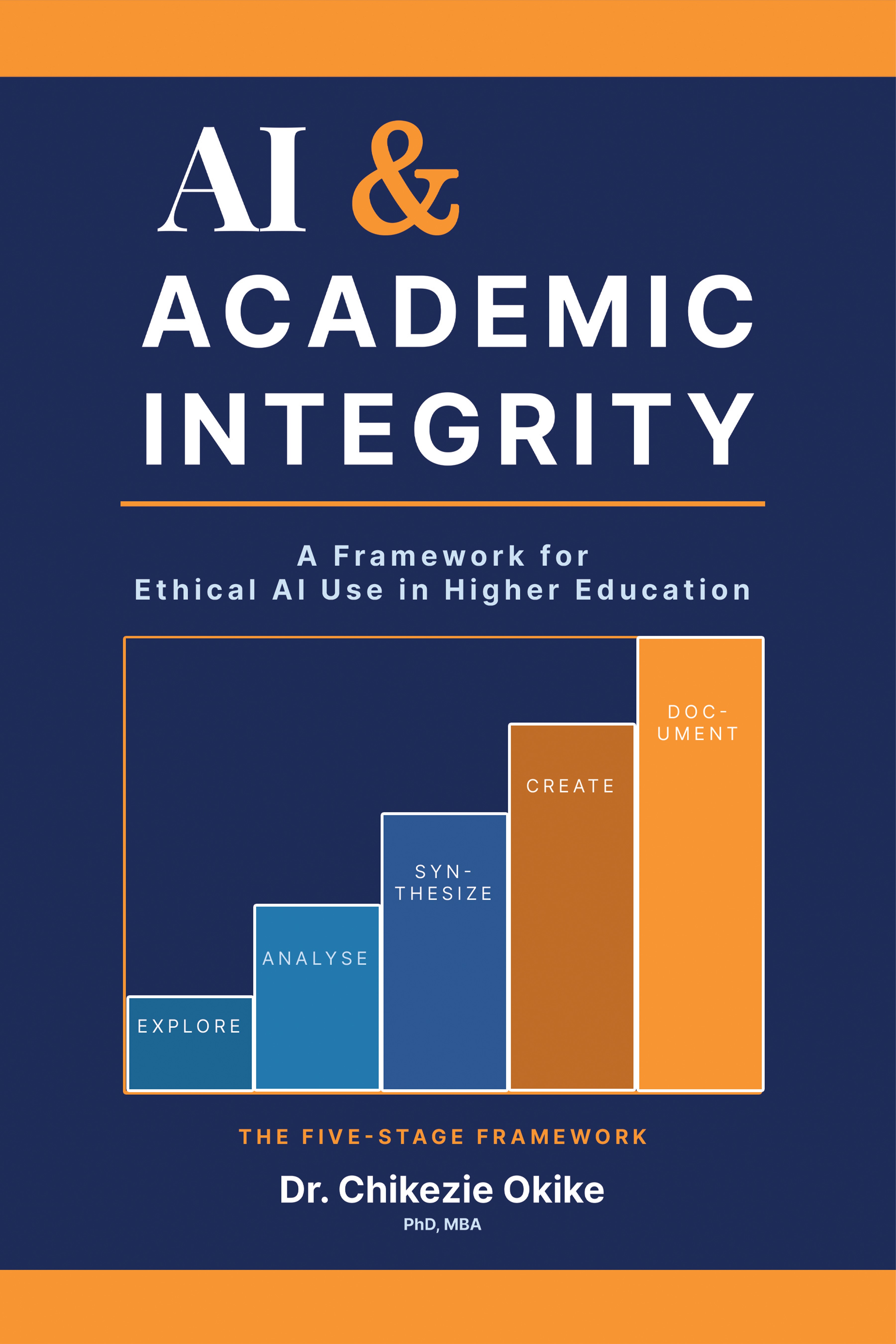
The foundation of all learning. You develop a genuine understanding of the topic, question, or problem. AI assists by clarifying concepts, answering factual questions, and surfacing relevant material — but the intellectual curiosity and direction remain yours.
You take the role of the analyst — evaluating sources, questioning assumptions, identifying gaps and contradictions. AI acts as a critical sounding board, challenging your interpretations and highlighting alternative perspectives.
You draw connections, develop original insights, and construct your argument. AI can assist with the logical flow and structure of ideas — but the insights, conclusions, and original thinking are entirely yours.
You design the work — its structure, argument, voice, and purpose. AI can assist with implementation details such as formatting, code, or visual arrangement. The creative vision, authorial voice, and academic judgement are yours.
You take full responsibility for transparency — declaring where and how AI was used throughout the process. AI can assist with formatting references and citations. Honest documentation is the cornerstone of academic integrity.
Download a one-page summary of the Five-Stage Framework — free.
Get the Free Framework SummaryA clear-eyed account of how AI has disrupted academic norms and why existing responses have fallen short.
A full chapter on each stage — with examples, scenarios, and guidance for applying the framework in practice.
Practical advice for students on how to use AI tools ethically across different assessment types and disciplines.
How to redesign assessments, update marking criteria, and have productive conversations with students about AI.
A step-by-step guide for universities and business schools developing or revising their AI use policies.
Real-world examples illustrating how the framework applies across disciplines, levels, and institutional contexts.
Taken together, these texts make a constructive contribution to maintaining academic standards while recognising that AI may also be used as a learning tool in some contexts. They merit consideration by institutions and teams reviewing policy, assessment practice, and student guidance in a rapidly changing area.
This is a major contribution in an era where academic institutions across the globe are and continue to wrestle with concerns and issues relating to plagiarism, authorship, and originality due to generative AI. This book and the workbook should be prominent in student and staff induction pack, classrooms and libraries.
As someone who has sat on academic misconduct panels, I found many integrity breaches in quantitative and professional disciplines do not arise from malicious intent but from uncertainty about boundaries. This book addresses that uncertainty directly. The book and workbook would translate well into teaching materials, workshops, or policy guidance.
Universities, business schools, and student unions are adopting the Five-Stage Framework as the basis for their AI integrity policies and recommended reading lists. Join the growing community of institutions leading on this issue.
We work with universities, business schools, student unions, and academic integrity offices to support curriculum adoption, staff training, and policy development based on the Five-Stage Framework.
Contact Us About Adoption →Add the book as a recommended or required text for undergraduate, postgraduate, or professional development programmes.
Use the Five-Stage Framework as the basis for your institution's AI integrity policy. Guidance and support available.
Institutional pricing available for bulk orders of 20+ copies. Contact us at enquiries@acadama.com for details.
Get a one-page summary of the Five-Stage Framework — ready to share with your students, team, or institution.
No spam. Just the framework. Unsubscribe any time.
Published by Information Managers Ltd, London · enquiries@acadama.com · www.acadama.com